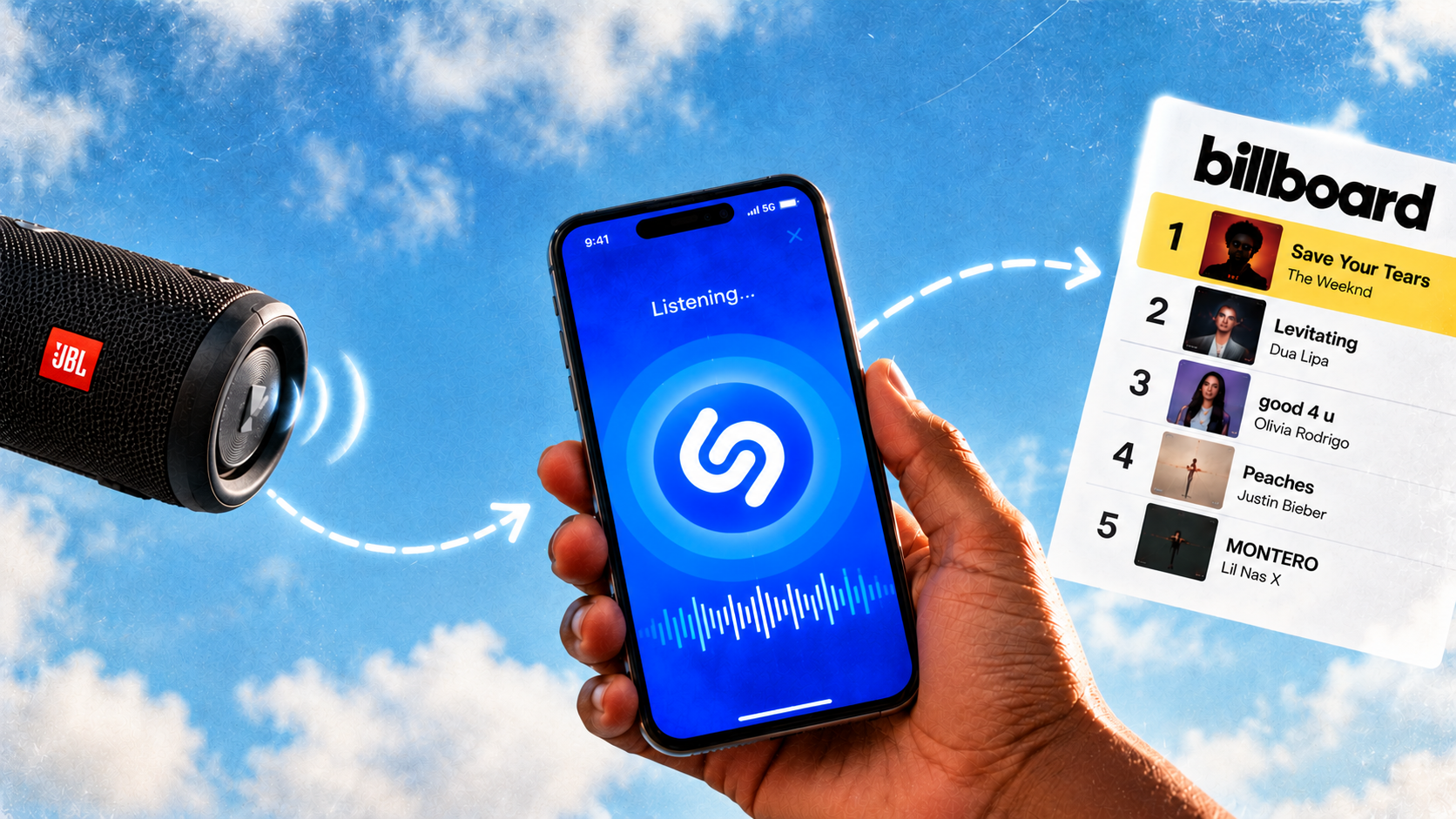
Someone hears a song they like, but they do not know the name. They pull out their phone, tap Shazam, and get an answer.
It feels like a simple convenience. But every time someone used the app, they revealed something the music industry could not easily see: which songs people were curious enough to stop and identify.
In the early 2000s, the industry was still largely shaped by record labels and radio. Labels decided which artists to promote. Radio programmers chose what to play. Charts reflected the songs that were already gaining attention.
Shazam gave listeners a small way to push back. They could not decide what went on the radio, but they could show what had caught their attention.
A different way to listen
Shazam’s founders started with a familiar problem. People heard music in bars, cars, and films, then struggled to find out what they were listening to.
The app offered a straightforward fix: hold up your phone, tap a button, and get the song title. The experience was built around convenience. You could identify the track and move on.
But those searches added up. A Shazam was more than a request for a song name. It was a sign that someone had heard something and wanted to know more.
That signal differed from a radio play or a marketing campaign. It did not show that a song had already been pushed to a large audience. It showed that a listener had noticed it.
At first, Shazam looked more like a clever feature than an industry tool. People used it, found the song, and went about their day. The music business was not immediately treating the app as a new source of influence.
Shazam kept collecting the searches. Over time, patterns began to emerge. A song could attract interest in one city before it appeared on radio. An unfamiliar artist could start gaining attention without the kind of label support that usually helped build an audience.
When curiosity became useful
A song getting thousands of Shazams did not automatically mean it would become a hit. But if the interest kept growing, or moved from one city to another, it gave the industry a reason to pay attention.
One radio programmer used Shazam data to add a song to rotation. That moment showed the company that its information could help people make decisions about what to play, not just help listeners identify what they had heard.
The value was in the gap between discovery and wider attention. If people were searching for a song before it had broken through on radio, that interest could offer an early clue about what might be gaining momentum.
Shazam’s charts made those patterns easier to see. A ranking of the most searched songs could show what people were looking for, including tracks that had not yet become mainstream hits.
That made the app useful to people across the music business. Labels and radio teams could look at search trends to spot songs attracting attention. For some emerging artists, Shazam interest helped build a case for a record deal.
The app did not make listeners into formal decision makers. They were not voting on a playlist or choosing who got signed. But their searches gave the industry another way to see what people were responding to.
Influence without taking over
Shazam’s role was unusual because it did not have to tell people what to listen to. Its users were already doing the work. They heard a song and chose to identify it.
That made the data valuable as a record of interest. A label could pay to promote a track, and a radio station could put it into rotation. A Shazam search showed that someone wanted to know more, though it could not explain exactly why or guarantee that the listener would become a fan.
That distinction matters. Search activity could point toward growing attention, but it was not a perfect forecast of success. It was one useful signal among many.
Shazam eventually became part of Apple. The simple experience remained familiar: hear a song, tap the button, get its name. Behind it, the searches had become a way to observe music discovery at a scale no individual listener could provide.
Shazam’s bigger contribution was not only recognizing songs. It helped make the moment of curiosity visible. A listener might not know who played the song or whether it would become popular. But the fact that they stopped to find out gave the industry a signal it had not previously been able to measure in the same way.
Sometimes the most revealing music data is not what people are already playing. It is the song they hear once and immediately want to find.