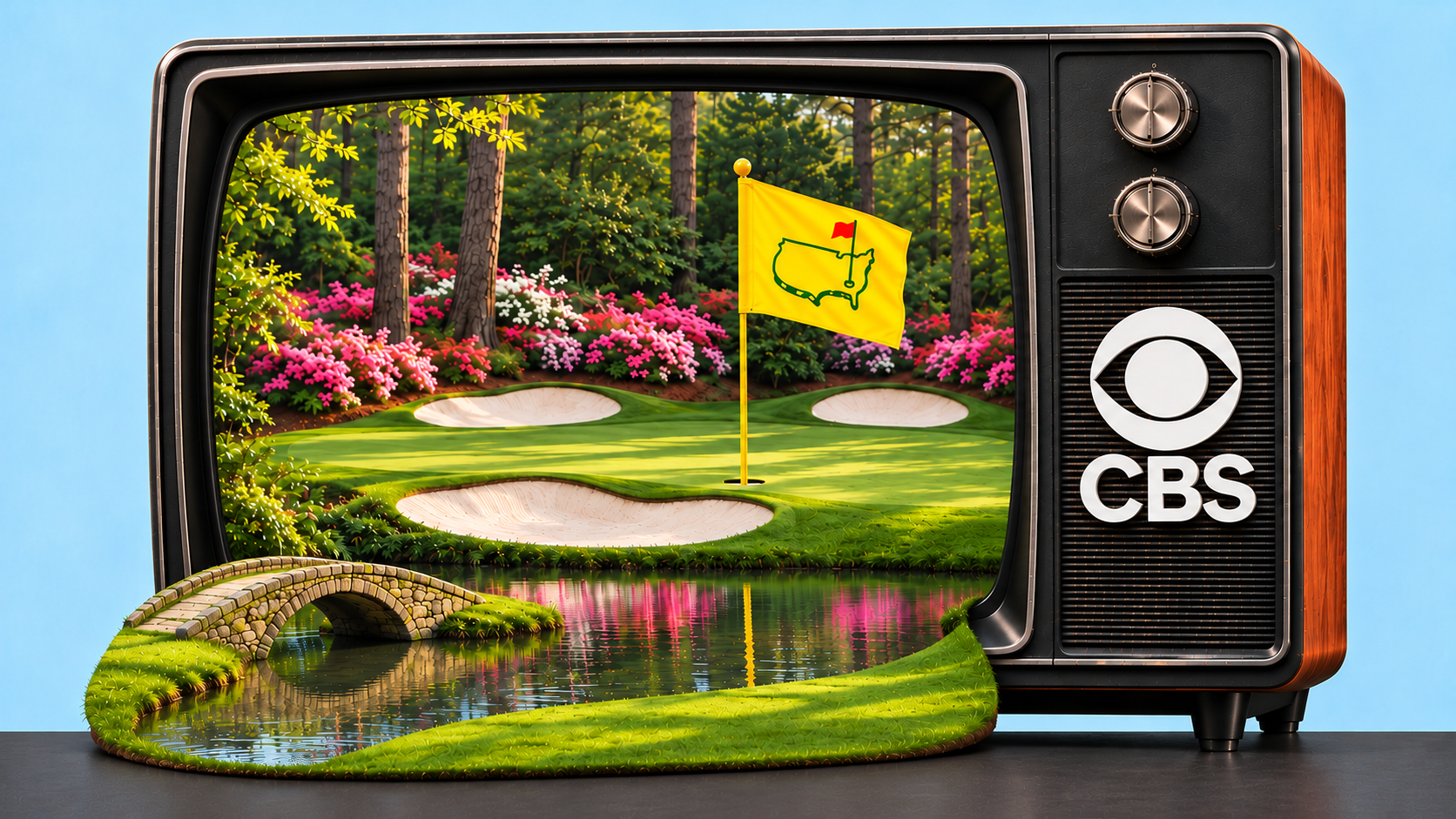
The Masters could be earning an estimated $100 million a year from its American television rights. Instead, Augusta National renews its deal with CBS one year at a time.
CBS has been broadcasting the tournament for decades, but Augusta has never committed to a long term agreement. That gives the club a chance to return to the negotiating table every year and decide whether the arrangement still works on its terms.
Why give up the security of a longer deal, and potentially leave so much money on the table?
The answer has a lot to do with how much control Augusta wants over the way the tournament appears on television.
A broadcast deal built on Augusta’s terms
CBS first broadcast the Masters in 1956. The original rights deal was worth $10,000 and covered the 18th hole. Augusta chairman Clifford Roberts wanted viewers to see more of the tournament, so he arranged for CBS to return half of the $10,000 and expand its coverage to the final four holes.
The arrangement was unusual from the start. As the years went on, leagues such as the NFL and NBA signed longer agreements worth billions of dollars. Long deals gave leagues more predictable revenue and gave networks the security of carrying major events for years.
The Masters kept renewing with CBS one year at a time.
A short contract does not automatically create leverage. Augusta’s position comes from having a tournament broadcasters want, while being willing to forgo some of the revenue a larger deal might bring.
That willingness is easier to understand when you look at Augusta National’s other income. The Masters brings in an estimated $155 million a year, with merchandise alone accounting for about $70 million to $80 million. Ticket sales, international television rights, and concessions add other revenue.
The club does not depend on its American television deal as its only source of income. That gives it room to prioritize how the tournament is presented, even if a broadcaster might be willing to pay more.
Four minutes of commercials an hour
Augusta puts strict limits on advertising during the broadcast. The Masters has a stated limit of four minutes of commercials per broadcast hour, which is why viewers can often watch for long stretches without an interruption.
That limit affects how much a broadcaster can earn from ads. It also helps create a viewing experience that feels different from other sports broadcasts.
Augusta’s control extends to the language used on air. A list of broadcast instructions from 1979 told commentators to call spectators “patrons,” refer to the front and back nine as the first and second nine, and use “bunker” and “second cut” instead of “sand trap” and “rough.” They were also told not to mention that tickets had sold out, estimate attendance, compare holes with other courses, or draw too much attention to a player’s antics.
The rules even covered the prize money. Commentators were expected to avoid making the $22.5 million purse a focus of their coverage. Jim Nantz has defended that approach, arguing that centering the money can take attention away from what the Masters celebrates: winning the green jacket.
The club has also shown that it will enforce its preferences. In 1966, CBS commentator Jack Whitaker called a crowd “the mob.” Augusta did not invite him back for the next five Masters, and he returned in 1972.
In 1994, commentator Gary McCord joked that the greens looked “bikini waxed” and made a remark about “body bags” behind a green. Augusta removed him from its coverage. CBS continued to use McCord on other golf broadcasts until 2019, but he was never invited back to the Masters booth.
The incidents show how seriously Augusta treats the presentation of its tournament. CBS gets access to a major sporting event. Augusta keeps unusually strong influence over what viewers hear and see.
What the viewer gets
The effect is visible in the commercial breaks. Sports Business Journal counted 17 and a half minutes of full commercials during CBS’s coverage of the 2026 final round, which ran for almost five hours, along with about a minute of separate sponsor acknowledgements.
For comparison, its count for CBS’s five hour broadcast of the PGA Championship a month later was 47 minutes of commercials. The categories were not exactly the same, but the difference shows how differently the two tournaments handle advertising.
During the Masters final round, CBS went about 40 minutes before its first 90 second commercial break, between 6 p.m. and Rory McIlroy’s final putt at 6:53. That gave viewers a long stretch with the tournament uninterrupted as the finish approached.
The restrictions have not stopped the event from drawing a large audience. The 2025 final round averaged 12.7 million viewers, up 33 percent as McIlroy won his first Masters. The rules did not cause those ratings, but they have not made the tournament less valuable to broadcasters.
A longer deal could still give Augusta strong control over the broadcast. Renewing every year gives the club another chance to decide whether CBS is meeting its expectations, and leaves open the possibility of negotiating again.
Forbes has estimated that the domestic television rights could be worth around $100 million a year. Augusta could pursue a larger check. Instead, it appears willing to pass up some potential revenue to maintain flexibility and protect the viewing experience it wants.
Viewers can see the result in the restrained advertising and the careful commentary. Augusta’s choice at the negotiating table becomes part of what people experience at home.
Is giving up that much potential revenue a smart way to protect control, or is it an enormous premium for a wealthy club to preserve its preferred image?