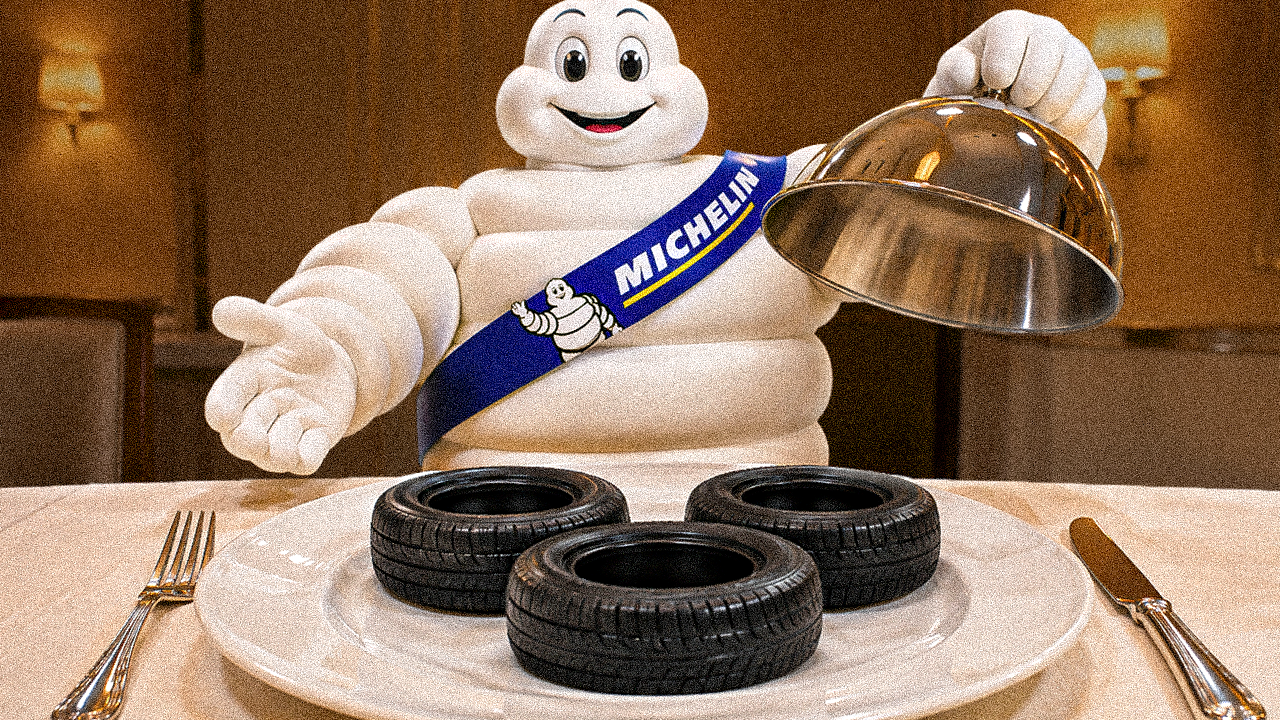
When a restaurant earns a Michelin star, the name behind the award belongs to a company that sells tires.
The connection makes more sense when you look at what Michelin needed people to do before they bought another set: drive.
In 1900, brothers André and Édouard Michelin were running a tire company in France. There were fewer than 3,000 cars in the country, and owning one could make even a short trip feel like a project. You had to find fuel, plan where to stay, and figure out what to do if the car broke down. There was no phone to call for help or pull up directions.
Michelin’s business depended on people using their cars. The more they drove, the sooner their tires wore out. But an advertisement could tell someone that Michelin made good tires and still leave them wondering whether a journey was worth the trouble.
So the brothers tried to make traveling easier.
A guide to getting on the road
Michelin printed nearly 35,000 copies of its first guide in 1900 and gave them away. It included maps, mechanics, fuel stops, hotels, and instructions for changing a tire.
The idea was practical: give motorists fewer reasons to stay home. Knowing where to go, where to sleep, and where to find help could make a trip feel more manageable.
Michelin expanded the service beyond the book. In 1908, it opened a travel bureau where motorists could request a planned route for free. The bureau received 19,000 requests a year by 1921. By 1925, it was receiving 155,000. Michelin had 120 people working on the service.
The numbers show that motorists were using what the company had built. They do not tell us how many extra trips those routes inspired or how many tires Michelin sold as a result. But the guide was giving people something useful between tire purchases.
Then, in 1920, Michelin started charging for it.
The story Michelin tells is that André visited a tire shop and saw copies of the guide being used to prop up a workbench. He supposedly decided people would take it more seriously if they had to pay for it. The guide went on sale for seven francs.
Around the same time, Michelin removed paid advertisements and gave more attention to its restaurant listings. Readers were interested in where to eat, and the company began developing a more detailed way to help them choose.
From restaurant listings to stars
A list of restaurants is helpful, but it does not tell you which one is worth the trip. In an unfamiliar place, you want more than a promise that a restaurant serves food.
In 1926, Michelin began marking standout restaurants with a star. By 1931, the rating system had expanded to one, two, and three stars.
Michelin also developed a process for evaluating restaurants. The company dates the creation of its professional inspector role to 1933. Inspectors visit anonymously, order meals, and pay their bills like other customers. That way, restaurants are less likely to give them special treatment.
The ratings are based on the cooking, including the ingredients, technique, flavours, the chef’s personality in the food, and consistency. Inspectors compare experiences across visits, and ratings are decided collectively with the guide’s leadership. If they disagree, Michelin arranges more visits until they reach a consensus.
In 1936, Michelin published what each rating meant. One star marked a very good restaurant in its category. Two stars meant excellent cooking “worth a detour.” Three stars meant exceptional cuisine “worth a special journey.”
The stars are awarded for the cooking, not the distance someone travels. But the descriptions connect the recommendation to the road. A two star restaurant might be worth changing your route for. A three star restaurant could be a reason to plan a trip around the meal.
That is a striking development for a guide that began by helping motorists handle the practical problems of travel. Michelin could help you find fuel and a place to stay. Now it could also give you a destination.
A relationship that lasts between purchases
Getting people to drive more could help create demand for tires, but motorists could buy replacements from any company. Michelin needed people to recognize and trust its name.
The guide gave the company more chances to be useful between purchases. Someone might buy tires only occasionally, but plan a trip, look for a restaurant, or consult a map more often. As Michelin’s recommendations became part of those decisions, the company had more opportunities to stay familiar to its customers.
Michelin’s head marketer later described maps and guides as a way to interact with people more regularly than tire purchases allow. The restaurant guide also connected the Michelin name with quality, an association the company could use beyond the restaurant world.
That became part of Michelin’s positioning. When the company expanded the guide to Bangkok in 2017, one stated aim was to strengthen its premium image as it competed with lower priced tire manufacturers.
There is a limit to what we can say about the original plan. We cannot know how many trips the first guide inspired or how many extra tires it helped sell. The Michelin brothers may not have anticipated that their restaurant ratings would become famous around the world.
But the logic behind the guide is clear. Michelin’s business benefited when people drove, and the guide gave motorists useful reasons to travel. Over time, its recommendations also gave them another reason to remember and trust the company.
Michelin did not just advertise tires. It built something people returned to when they wanted to plan a journey, choose a restaurant, or decide where to go next.