.svg)

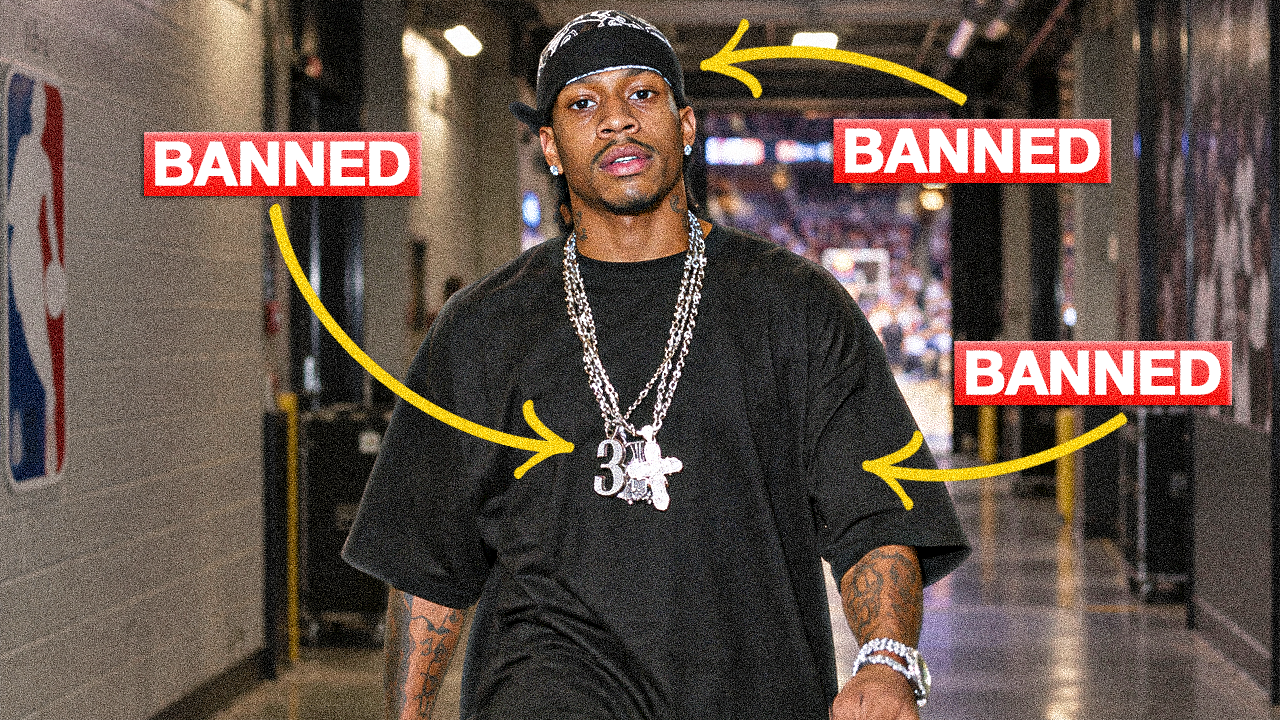
In 2005, the NBA decided to ban players from wearing durags, chains, and throwback jerseys to games. For over 20 years, David Stern took the blame for the NBA dress code even though he insisted the rule was never his idea. This one policy, designed to control how players looked, ended up doing the exact opposite. The players took back control of their image and turned the restriction into something far more powerful than the league ever expected.
So it's October 17th, 2005, and the NBA has just sent a memo to every team in the league telling them that within two weeks, players can no longer wear durags, throwback jerseys, sleeveless shirts, or chains to games or any league event.
When the news came out, players were angry. A few saw it as racist and as an attack on Black culture.
For the longest time, everyone thought it was David Stern who pushed for the dress code. But behind closed doors, it was actually the NBA Players' Union who pushed for it before Stern ever made it public.
The Players' Union negotiates the collective bargaining agreement with the league on things like salary structure, revenue sharing, and free agency rules. The dress code came up inside that machinery, not on a podium.
One of the key drivers that pushed Stern to enforce it was what happened in a game between the Indiana Pacers and the Detroit Pistons on November 19, 2004. Or what is now known as the Malice at the Palace.
Nine players from the Pacers and Pistons got into a full on brawl for 10 minutes that spilled into the stands. You had players throwing punches at fans, fans throwing beer onto the court, chairs being tossed at players. It was pure chaos.
In total, all nine players faced major suspensions and lost roughly $11 million in salary.
The Malice at the Palace created a much bigger problem for Stern and the league office. The league's collective image took a massive hit, their largest sponsors started getting nervous, and TV ratings were sliding.
The league had spent years building their audience around hip hop. Now they needed to sell the same product to a far more conservative, corporate crowd.
So in their next CBA meeting, the topic of the player dress code came up. According to Stern's account years later, it wasn't something he brought up or forced on anyone. He said it was the Players' Union who told him it was a good idea to implement, and that it came out of the negotiation before it was ever presented to him.
After watching what happened between Detroit and Indiana, Stern took the proposal and ran with it. The rules were simple. All players were expected to be dressed business casual at all league affairs. No jerseys, no durags, no jewelry outside the shirt.
What's interesting is that if the union really signed off on it, someone forgot to tell Antonio Davis, who was leading the NBPA at the time. He came out publicly and said he didn't think it was fair for the league to tell players how to dress. Which was strange, since Stern said the NBPA had already approved it, and Davis was acting like he'd never seen it before.
So it's either that the union's leadership signaled something during a closed door negotiation that never reached its own members, or Stern was doing damage control.
Adjusting to the policy was tough on the players. The pushback didn't just show up in the tunnel. It showed up on the court too.
Players started wearing their basketball shorts longer than what was allowed. The league's rule was that game shorts had to end at least one inch above the knee. That rule had been on the books for years, but the NBA began enforcing it far more aggressively that season.
By December 2005, 13 players had been fined $10,000 each for wearing their shorts too long. Nate Robinson, Stephon Marbury, Jermaine O'Neal, and Allen Iverson all got hit, and their teams paid another $50,000 for every single violation on top of that. Philadelphia alone had four guys on the list. The league was citing more than twice as many players as the season before.
Paul Pierce came out and said the banned pieces were part of their culture. Jason Richardson called the chain rule racist. And Raja Bell said the quiet part out loud in a media scrum, arguing the policy was really about making the league look better to corporate money, and that corporate money wasn't the crowd actually buying tickets to the games.
Whatever the union did or didn't sign off on, they took none of the backlash. Stern became the fall guy for all of it.
But something interesting began to happen as the season went on. The policy didn't kill player expression. It did the opposite and amplified it.
Locked out of durags, jerseys, and chains, players started competing over something new. Arriving at the arena turned into a contest to outdress the next guy, and the tunnel started looking like a runway on game days.
Those tunnel looks created a whole new business around getting players dressed for a game. One of the key people driving it was Dan Solomon.
He was studying fashion at Indiana and flipping sneakers on the side when he became friends with OG Anunoby. When Anunoby got drafted to Toronto, Solomon started bringing clothes to his hotel room whenever the Raptors came to play in New York.
Other players caught on and started asking for the same thing. Shopping out of a hotel room meant they could buy without getting recognized and harassed in stores.
So Solomon started buying the inventory himself and selling it out of a hotel suite whenever teams came through town. By 2023 he was running over 100 of these pop ups a year.
The media side took off when Ian Pierno started an Instagram account called LeagueFits. It was built on nothing but photos of players walking from the parking lot to the locker room. The account got so big that it became a full publication under SLAM Magazine with its own podcast.
Once the audience was there, teams figured out they could sell it. It started with the Golden State Warriors, who turned player arrivals into a sponsored segment called Rakuten Arrivals. Now every team in the league runs a variation of it on their Instagram accounts.
That walk from the car to the locker room is ad space now, and somebody's paying for it.
Russell Westbrook didn't just wear the fashion. He built a company out of it called Honor the Gift and turned his tunnel walk into an actual business with his name on it.
The NBA opened up a new lane for sports fashion, and the rest of the industry followed. The WNBA stopped treating fashion as a side effect and started treating it as a business line. The NFL hired its first ever fashion editor in 2025 and signed Abercrombie and Fitch as an official partner. It even reached F1, where Lewis Hamilton started showing up to the paddock in designer pieces instead of team gear and launched his own clothing line. Fashion in sports has gotten so serious that ESPN handed out its first ever Best Tunnel Fit award at the ESPYs.
By 2014, when Stern handed the league over to Adam Silver, the culture war was already over and the players had won. Silver loosened the code almost right away, because there was nothing left to defend. The players hadn't just accepted the dress code by then. They'd out earned the reason it existed.
Stern spent years trying to control what players looked like, and ended up accidentally creating an economy built on how they look.


%20(1).jpeg)

.png)
.png)
.png)