.svg)

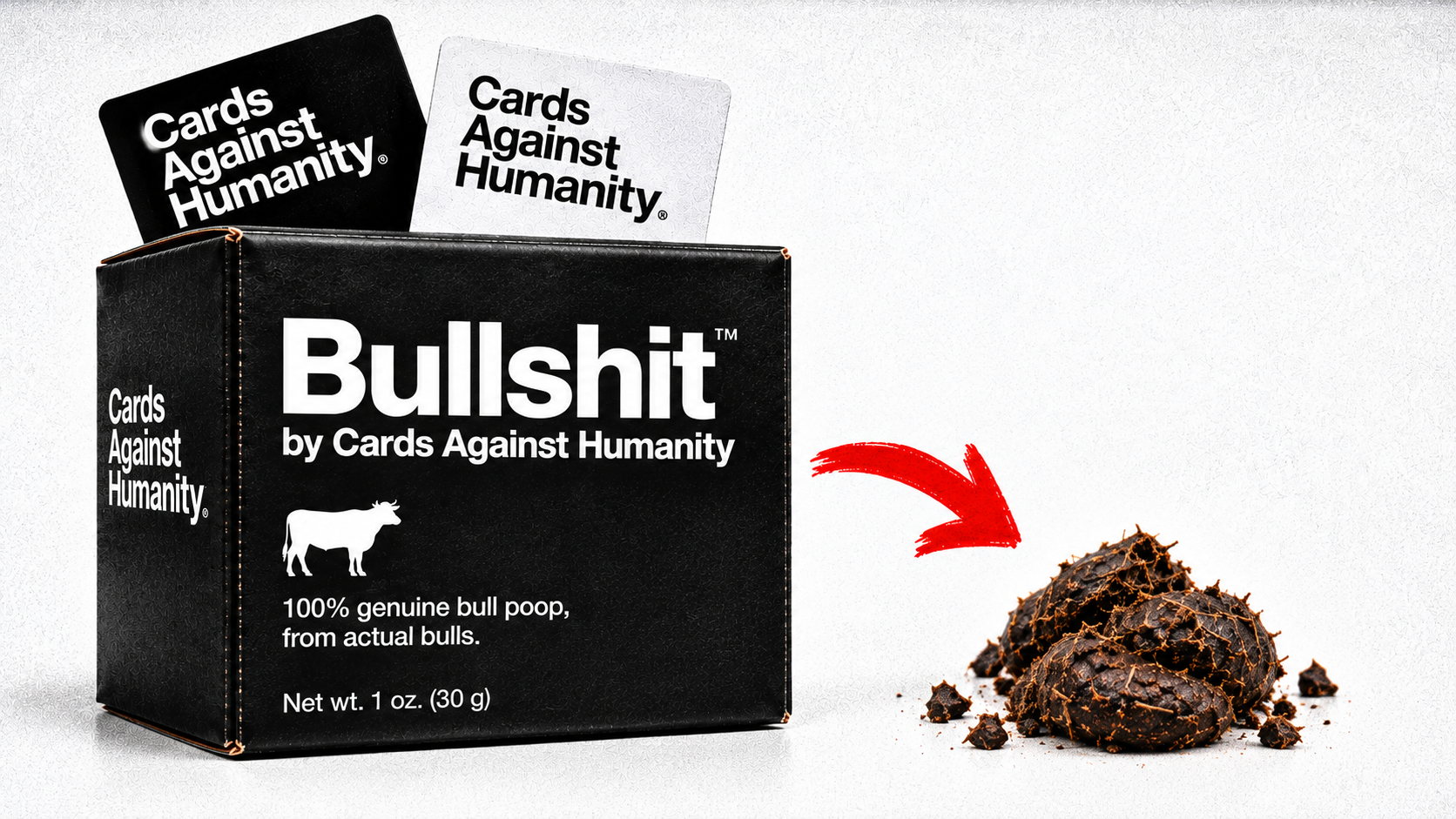
Cards Against Humanity sold 30,000 boxes of actual poop on Black Friday in 2014.
They charged $6 a box and made it very clear there wasn't a hidden card or secret prize inside.
It was straight doo doo, and people still bought it.
But as crazy as it sounds, poop wasn't even the worst deal they ever offered.
The following year, they found something to sell that was worth even less.
And somehow, the worse these deals got, the stronger Cards Against Humanity became.
Cards Against Humanity started as a party game created by a group of friends from Chicago. The whole concept behind it was simple.
One person reads a question or a fill in the blank statement from a black card, and everyone else tries to give the funniest answer they can using one of their white cards.
But unlike most family friendly games sitting on store shelves at the time, Cards Against Humanity was intentionally offensive, inappropriate and willing to make jokes that most companies would never touch.
The first version of the game was funded through Kickstarter in 2011, where the creators originally set out to raise $4,000 and ended up bringing in $15,000.
It wasn't a lot of money, but the game caught on pretty quickly.
They also did something unique for a company trying to sell a physical card game.
They let people download it for free.
Anyone could go onto their website, download the cards, print them out and play without giving Cards Against Humanity any money at all.
By 2013, more than 1.5 million people had downloaded the free version.
And at the same time, people were still buying the physical game.
By the end of that year, Cards Against Humanity had sold close to half a million decks and generated $12 million for its creators.
What made that even more interesting was that all of this was happening while more than 1.5 million people had the game for free.
Giving the game away clearly wasn't stopping people from buying it.
If anything, it showed Cards Against Humanity that getting more people involved with the brand could be more valuable than trying to make money from every single person who came across it.
This way of thinking would become a big part of what they eventually did with Black Friday.
It first started in 2012, when they released a holiday expansion where customers could choose how much they wanted to pay for it.
That experiment generated more than $70,000 and gave them insight into how much their customers were willing to spend.
So by the time Black Friday came around the following year, they already knew their customers were willing to play along when they messed around with the pricing.
But Black Friday created a different problem.
They didn't have the advertising budget to compete with the biggest retailers in the world.
Which meant that during the holidays, when every company was fighting for the same attention, Cards Against Humanity could easily get drowned out.
They knew they didn't have the capacity to outspend everybody.
So they needed to come up with something no one else was doing.
To understand how they eventually ended up shipping 30,000 boxes of poop across America, we have to take it back to Black Friday 2013.
During this time, every retailer was pretty much doing what you would expect them to do.
They were lowering prices, offering limited time deals and trying to convince people that their Black Friday sale was better than everyone else's.
Cards Against Humanity saw this and decided to experiment with doing the opposite.
Instead of putting their game on discount, they increased the price by $5.
They did this on their own store, on Amazon and on their Canadian Shopify store.
It was a risky play.
They already had a successful product, and now they were voluntarily making it more expensive on the one day customers expected everything to be cheaper.
It was a ballsy move. If people didn't find the joke funny, they were basically giving customers a reason not to buy the game.
But when their customers saw this, the exact opposite happened.
Cards Against Humanity ended up selling more than it did the previous Black Friday.
The game outperformed the normally priced days leading into it and held its position as the best selling game on Amazon.
Then, once Black Friday ended and the price came back down, sales jumped even higher the following day.
Cards Against Humanity jokingly called it "Regret Saturday."
Their cofounder, Max Temkin, described the whole experiment as an ad that paid them to run it.
That first experiment laid the foundation for how they would approach every Black Friday to come.
They looked at the results and thought, maybe we don't need the biggest discount to get people talking about us.
Maybe doing the exact opposite of what everyone expected was more valuable.
So going into the following Black Friday, they were left with a pretty interesting question.
How far were they willing to take things to make some noise?
It's hard to believe, but their conclusion after ideating everything was poop. Yes, poop.
So for Black Friday 2014, Cards Against Humanity removed all of its actual products from its online store.
As a customer, you had nothing to buy when you went on their website.
The only thing they were selling was a product they called "Bullshit."
The offer was simple. For $6, Cards Against Humanity promised to mail you actual poop from an actual bull.
And this wasn't fake novelty poop they ordered from some gag company.
They actually found a rancher in Texas and bought manure from her.
They created custom packaging for it and built an entire fulfillment operation around getting boxes of it into people's homes.
When this dropped, people immediately started thinking there had to be more to it.
People online thought it was a ploy, with an exclusive card or something big hidden somewhere inside the package.
Others thought there could be some kind of secret prize one lucky customer would get, because there was no way a company was actually going through all this trouble just to mail people poop.
But Cards Against Humanity kept telling them over and over that there wasn't a catch.
If you paid $6, you were actually getting poop.
That was the deal.
And even after being warned, you'd think people would back away.
They didn't. 30,000 people pulled out their credit cards and bought the poop.
All 30,000 boxes sold out that Black Friday.
At $6 each, Cards Against Humanity had just brought in $180,000 selling something most people would normally pay someone else to get rid of.
And when you actually look at the economics behind the stunt, the whole thing makes even less sense.
Cards Against Humanity later released a breakdown of what it cost to put every order together.
The actual poop only cost about 27 cents, but that was just one small part of the expense.
The custom box cost $1.55. Once you added the pin, another box for shipping, freight, handling, postage and the credit card fee, Cards Against Humanity was spending about $5.80 to sell something for $6.
That left them with roughly 20 cents on every order.
So after finding a rancher to supply the manure, creating custom packaging, fulfilling 30,000 individual orders and shipping all of those boxes around the country, Cards Against Humanity walked away with about $6,000.
They ended up donating the money.
But let's rewind and think about what they had just done.
On the biggest shopping day of the year, they stopped selling the product that actually made them money.
They replaced it with something that required an entire supply chain to put together, all so they could make roughly 20 cents every time someone bought it.
If the goal was simply to make money selling poop, this was a terrible business idea.
But the poop was never really the product.
The attention was.
As the story spread, people were posting about it online, news outlets were covering it and customers were filming themselves opening their packages to see whether the company had actually followed through.
And the funny thing is that even after being told there was nothing else inside, some customers still couldn't believe the joke could really be that simple.
Cards Against Humanity had been telling them the truth the entire time.
While everyone was laughing about people spending $6 on poop, Cards Against Humanity was getting the attention every retailer was fighting for that weekend.
Think about what Black Friday looks like from a company's perspective.
Every retailer is advertising at the exact same time. They're lowering prices, putting out limited time offers, and they're all trying to convince customers that their discount is somehow better than the one right beside it.
Cards Against Humanity could've joined that fight and offered something like 20% off its game.
But they didn't have the budget to out advertise everyone.
So instead, they gave people a story that was almost impossible not to talk about.
And according to the company, all of that publicity didn't just disappear once Black Friday ended.
Just like the price increase the year before, the attention around the poop stunt helped drive sales of their actual products afterward.
Cards Against Humanity had figured out that they didn't have to win Black Friday by offering the best deal.
They could win attention by offering the worst one.
Once they realized people were willing to play along, they kept pushing the idea to see what else they could get away with.
So the following Black Friday, in 2015, they came up with something even more ridiculous than selling poop.
They decided to sell nothing.
They took their normal store down again, but this time there wasn't even a ridiculous product waiting for you.
They simply asked people to give them $5, and in exchange, those people would get absolutely nothing.
There wasn't even going to be an empty package arriving at your door a few weeks later.
You gave them $5, and they kept it.
That was it.
Guess how many people decided to do this?
11,248 people.
But here's where it gets even crazier.
Almost 1,200 of those people didn't stop at $5.
They were so eager to give Cards Against Humanity money that they went through the process multiple times, just to pay even more for absolutely nothing.
One person reportedly gave them $100.
By the time the stunt was over, they had collected $71,000 without selling a single thing.
And lucky for them, this time they didn't have to source manure, create custom packaging or pay for postage, because there wasn't a product to fulfill.
The Cards Against Humanity team split the money among their employees and publicly showed people some of the things they spent it on.
When you look at these three Black Fridays together, you realize these weren't just random stunts they came up with every year.
Every year, Cards Against Humanity removed another reason someone would normally have for spending money.
In 2013, they took away the discount.
You still got Cards Against Humanity, but you had to pay more for it.
In 2014, they took away the game.
You still received something in the mail, but that something was poop.
In 2015, they took away the product completely.
You gave them money and got absolutely nothing in return.
Every year, the transaction made less sense, and the brand made more sense.
Cards Against Humanity understood what made this strategy work.
Black Friday isn't only a competition for people's money. It's also one of the biggest competitions for people's attention.
Every company is trying to get noticed on the same weekend, and most of them are doing it with some version of the exact same message.
Our price is lower.
Our discount is bigger.
Our deal is better.
Cards Against Humanity realized that trying to beat everyone at the same game didn't really fit who they were as a company.
So instead of trying to offer the best Black Friday deal, they went as far as they possibly could in the opposite direction.
But there's another part of this that explains why the strategy kept working year after year.
Cards Against Humanity could come up with the joke, but they couldn't finish the joke themselves.
The customers had to do that.
Selling poop isn't nearly as interesting if nobody buys it.
Offering nothing for $5 isn't much of a story if nobody actually pays.
Cards Against Humanity created the setup, and thousands of people willingly became part of the punchline.
Max Temkin compared the relationship to an improv scene, where the company could start the joke, but the public had to participate to make the whole thing work.
And that meant the marketing wasn't something their customers were simply watching.
The customers were actually part of the marketing.
Someone spending $6 on poop isn't really doing it because they suddenly see value in manure.
They're doing it because they get to be part of the joke, tell someone they actually bought it and eventually open this ridiculous package when it arrives.
Then that person posts about it, someone else sends the story to a friend, a news outlet covers it, and suddenly the customer who bought the joke is helping spread it.
The same thing happened when people paid for nothing.
And it worked because it felt exactly like Cards Against Humanity.
The game itself was built around saying things other companies wouldn't say and crossing lines most brands wouldn't touch.
And getting people to laugh because they couldn't believe someone actually went there.
Eventually, their marketing started doing the exact same thing.
They weren't just advertising Cards Against Humanity anymore.
The advertisement itself felt like playing Cards Against Humanity.
That allowed them to turn Black Friday from a day where they had to compete with everybody else's discounts into an annual event that belonged to them.
The crazier the stunt became, the more people wanted to participate, and the more everyone else wanted to see what they would do next.
This was never really about selling poop.
It was about understanding that when every company is fighting for attention by doing the same thing, sometimes the most valuable move you can make is giving people something completely different to talk about.
If you enjoyed this, make sure to follow along. We share stories like this every week.


%20(1).jpeg)

.png)
.png)
.png)